Quick Answer
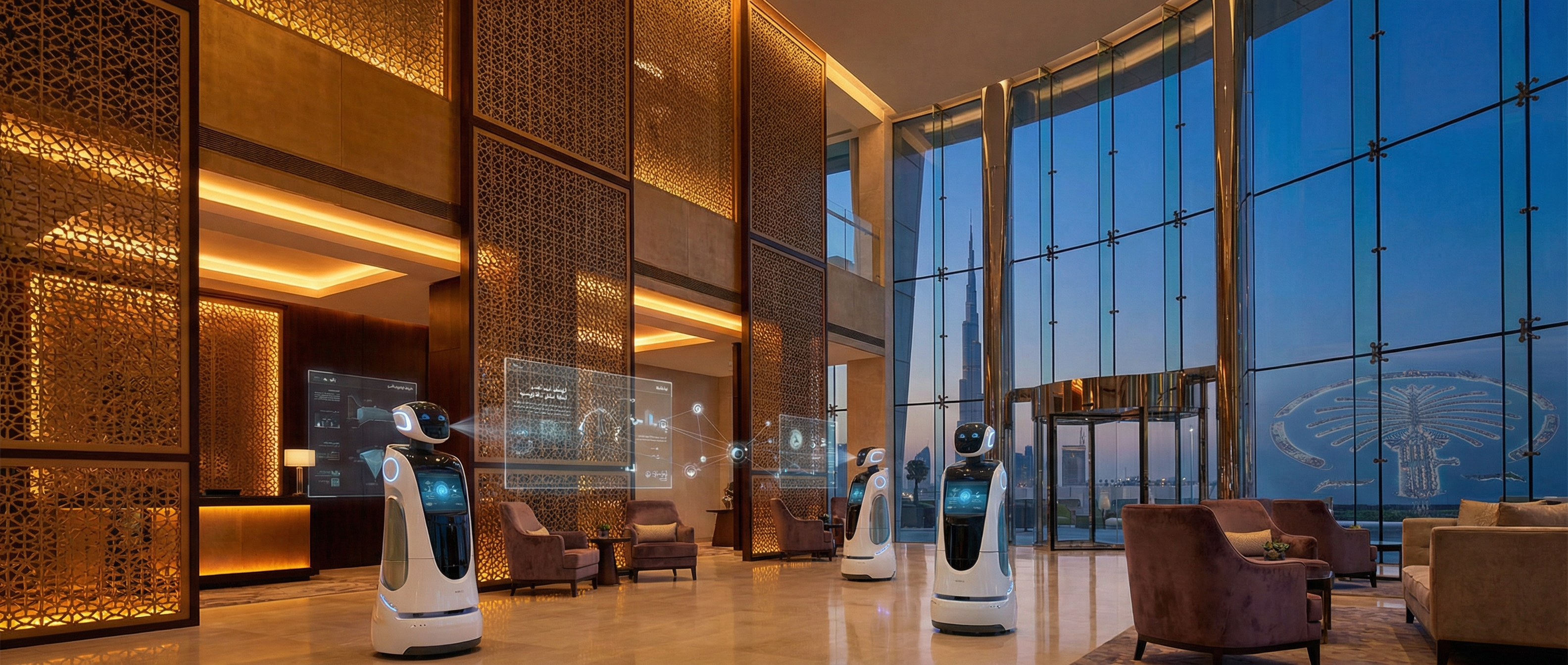
Dubai hotels use AI automation for contactless biometric check‑in, 24/7 AI concierge services, predictive operations management, and hyper‑personalized guest experiences. This AI automation maturity lets properties deliver faster service without adding headcount. As of early 2026, 91% of Middle East hospitality leaders have implemented or are testing AI solutions, and Dubai leads the region with a government‑backed citywide contactless hotel check‑in framework that lets guests bypass the front desk entirely.
Table of Contents
- The State of AI in Dubai's Hospitality Industry
- Contactless Check‑In: Dubai's Game‑Changer
- AI Concierge and Voice Automation
- Predictive Operations and Resource Management
- Personalization at Scale
- Challenges and Implementation Realities
- Frequently Asked Questions
The State of AI in Dubai's Hospitality Industry
Dubai's hospitality sector has moved from experimentation to deployment. A February 2026 PwC Middle East report shows 91% of hospitality leaders in the region are using or testing AI. Yet only 3% report enterprise‑wide deployment, revealing a gap between adoption and real impact.
The core bottleneck isn't budget. Nearly three‑quarters of hospitality groups now have dedicated AI funding. The constraint is people and process: 73% of organizations lack staff with the skills to manage AI tools or lead digital transformation. This creates a paradox where tools exist, but teams struggle to connect data, integrate systems, and scale beyond isolated pilots.
Dubai has unique advantages that accelerate AI automation in hotels:
- Government support: Dubai's D33 economic agenda encourages smart‑city infrastructure and service productivity.
- Digital‑first guests: Over 95% smartphone penetration and strong comfort with biometric systems.
- Global visitor mix: International travelers expect cutting‑edge experiences.
- Regulatory alignment: Innovation is encouraged in new hotel developments.
In this environment, early adopters are already processing higher volumes with smaller teams, delivering better experiences at scale, and operating with stronger margins than traditional competitors.
Contactless Check‑In: Dubai's Game‑Changer
In January 2026, Dubai rolled out a citywide contactless hotel check‑in system that changed arrivals across the emirate. For many properties, this is the first visible AI automation milestone for guests. This is not a chain‑specific app—it's a unified, government‑backed framework that all licensed hotels and holiday homes can integrate.
How the System Works
- Pre‑arrival registration: Guests upload ID documents and complete biometric verification in advance.
- One‑time verification: Once approved, data remains valid until the ID expires.
- Facial recognition access: Future stays require only a quick facial scan.
- Instant room access: Guests proceed straight to rooms without a front‑desk queue.
Hotels such as Crowne Plaza Dubai Marina report guests reaching rooms in around 90 seconds from entering the lobby, compared to 10–15 minutes during peak periods.
Business Impact
- Reduced congestion: Lobbies stay clear even during group arrivals.
- Lower staffing pressure: Front desk teams shift to higher‑value guest care.
- Faster peak handling: Properties manage surges without temporary staff.
- Higher guest satisfaction: Repeat guests avoid repeated verification.
A January 2026 Gulf News analysis noted that standardized adoption across Dubai creates consistency that individual chains cannot match alone. Integration typically costs AED 75,000–200,000 depending on property size, with ROI in 8–12 months through labor savings and efficiency gains.
AI Concierge and Voice Automation
Beyond check‑in, hotels are automating service delivery through AI concierge systems that handle routine requests without human intervention. These AI automation layers keep service consistent across shifts.
24/7 AI Concierge Services
Examples from Dubai and the wider UAE market include:
- Four Seasons Dubai uses voice automation to route guest calls and requests.
- TIME Hotels deploys AI for pre‑arrival communication, in‑stay updates, and post‑stay feedback.
- Marriott properties use AI voice agents for room service, wake‑up calls, and amenities.
These systems typically manage 60–70% of repetitive guest interactions such as temperature adjustments, extra towels, restaurant recommendations, or simple reservations. Human staff are freed to handle complex issues that require empathy and judgment.
A February 2026 Travel and Tour World report noted that AI automation enables Dubai and Abu Dhabi hotels to personalize experiences at scale by capturing preferences such as room type, dining habits, and leisure interests. One Abu Dhabi hotel reduced first response time from four hours to two minutes while resolving 68% of inquiries without human agents after launching Arabic‑enabled AI support.
Multilingual Capability
For Dubai's international market, Arabic‑English support is mandatory. Successful deployments support formal Arabic plus regional dialects, not just translated scripts. Implementation costs for AI concierge systems usually range AED 120,000–350,000 annually for mid‑sized properties (200–400 rooms), including licensing, integration, and optimization.
Predictive Operations and Resource Management
The most significant financial impact of AI in hospitality often comes from behind‑the‑scenes operations, where AI automation can optimize costs without affecting guest comfort.
TIME Hotels demonstrates advanced predictive operations across its regional portfolio. Their AI systems handle:
- Dynamic pricing: Real‑time rate adjustments based on demand and booking velocity.
- Smart building systems: Automated energy and water optimization.
- Predictive maintenance: Equipment monitoring to prevent failures.
- Guest analytics: Data‑driven personalization.
According to a January 2026 International Business Magazine report, this AI approach drives revenue optimization while reducing costs through predictive resource management. For Dubai hotels, energy expenses are significant; predictive systems typically deliver 15–25% utility savings in year one. For a 300‑room property spending AED 180,000 monthly on energy, that’s AED 27,000–45,000 in monthly savings.
AI also improves procurement. Forecasting models analyze occupancy history, events, weather, and promotions to predict demand for linens, F&B inventory, and amenities. This reduces stockouts and overstock, typically improving inventory efficiency by 20–30%.
Personalization at Scale
Dubai’s luxury hospitality market expects individualized experiences. AI automation delivers personalization without proportional staffing increases.
Modern systems build guest profiles tracking:
- Preferences: room temperature, pillow type, minibar, newspapers
- Behavior: typical arrival times, dining habits, spa usage
- Occasions: birthdays, anniversaries, business travel patterns
- Channel preferences: WhatsApp vs email, Arabic vs English
When repeat guests book, AI pre‑configures rooms and alerts relevant teams about dietary needs or special requests. A February 2026 hospitality analysis highlighted how AI systems can detect guest sentiment in real time. If satisfaction appears low, the system can alert guest relations, offer a complimentary amenity, and prioritize their requests—preventing negative reviews.
Advanced hotels use AI to personalize pricing and offers based on loyalty tier, price sensitivity, inventory levels, and competitor activity. Comprehensive personalization platforms cost AED 250,000–600,000 in the first year but typically deliver 10–20% increases in RevPAR through higher conversion and guest spend.
Challenges and Implementation Realities
Despite strong benefits, Dubai hotels face real obstacles when scaling AI automation:
- Skills gap: 73% of organizations lack staff capable of managing AI systems.
- Integration complexity: Legacy PMS/CRM systems require careful integration.
- Data quality: AI needs clean, structured data.
- Change management: Staff must adapt to new workflows.
- Regional adaptation: Arabic language processing, cultural sensitivity, Ramadan patterns, and UAE data‑privacy compliance.
Hotels often partner with specialized consultancies like Sinasoft to bridge the gap between AI technology and hospitality operations.
Payback periods average 9–12 months for hospitality automation projects. Expect AED 150,000–800,000 upfront depending on scope, plus ongoing licensing, training, and optimization. Comprehensive systems usually require 3–6 months for deployment and improvement through iteration.
Frequently Asked Questions
What percentage of Dubai hotels currently use AI automation?
February 2026 PwC data shows 91% of Middle East hospitality leaders are using or testing AI, with Dubai leading regional adoption. Only 3% have full enterprise‑wide deployment—most hotels start with specific use cases like check‑in or guest communications.
How much does it cost to implement AI automation in a Dubai hotel?
Typical mid‑sized hotel investments include:
- AI chatbot/concierge: AED 120,000–200,000 annually
- Contactless check‑in integration: AED 75,000–150,000 one‑time
- Comprehensive automation: AED 500,000–1,200,000 first year
ROI usually appears within 9–12 months.
Does AI automation reduce jobs in Dubai hotels?
No. AI shifts roles from repetitive transactions to higher‑value guest engagement. Hotels redeploy staff into guest relations, upselling, and experience management roles while maintaining headcount.
Can AI systems handle Arabic‑speaking guests effectively?
Yes, when platforms provide native Arabic NLP, not simple translation. Leading systems handle formal Arabic and regional dialects. UAE hotels should test Arabic capability before deployment.
What is Dubai's citywide contactless check‑in system?
Launched in early 2026, it’s a government‑backed framework allowing guests to register once via biometric verification and use facial recognition for future stays. All licensed hotels and holiday homes can integrate it, enabling 90‑second check‑ins without front desks.
How can my Dubai hotel start implementing AI automation?
Start with one high‑impact area:
- Identify bottlenecks (queues, repetitive inquiries, energy waste)
- Choose one application (contactless check‑in, AI concierge, or predictive pricing)
- Pilot before scaling
- Measure results against baselines
- Train staff thoroughly
Contact hospitality AI specialists at [email protected] to discuss your automation roadmap.
About Sinasoft
Sinasoft is a Dubai‑based AI automation consultancy specializing in custom AI solutions for UAE businesses. We help companies implement compliant, Arabic‑enabled automation that saves time and increases ROI, with particular expertise in hospitality, retail, and service industries across the Middle East.
Ready to Transform Your Hotel Operations with AI?
Dubai’s hospitality landscape is evolving quickly, and properties that delay AI automation risk falling behind competitors already capturing efficiency and guest‑experience advantages. Whether you’re exploring contactless check‑in, AI concierge systems, or predictive operations, the right implementation partner makes the difference between underperforming technology and measurable results.
Contact Sinasoft today to discuss your hotel’s AI automation roadmap.
Email: [email protected]
Website: https://sinasoft.co/contact
Let’s build AI automation that enhances guest experience, reduces operational costs, and positions your property at the forefront of Dubai’s hospitality innovation.