Quick Answer
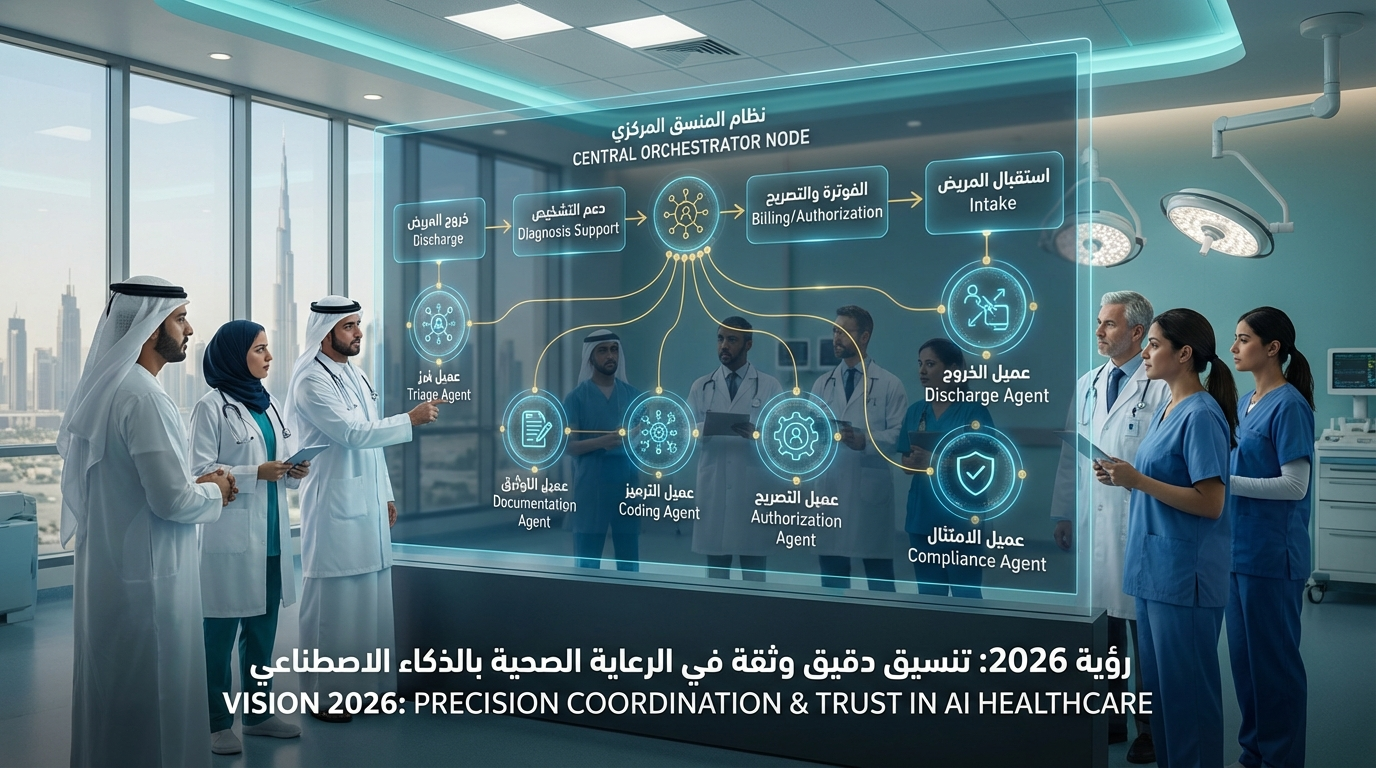
Yes—multi-agent AI can improve Dubai healthcare workflows in 2026 by assigning specialist AI agents to triage, scheduling, diagnostics support, coding, prior authorization, discharge planning, and compliance checks, all coordinated by one orchestrator. For UAE providers, this model reduces bottlenecks, lowers avoidable admin cost in AED, and improves patient flow without replacing clinicians. The key is governance with clear escalation rules and phased rollouts.
Table of Contents
- Why Dubai Healthcare Is Moving to Multi-Agent AI Now
- What Multi-Agent AI Means in a UAE Hospital Context
- The Core Specialist Agents That Matter Most
- How the End-to-End Patient Workflow Changes
- Integration with Existing UAE Healthcare Systems
- Cost Model and ROI Benchmarks in AED
- Risk, Safety, and Compliance in Dubai and Abu Dhabi
- Implementation Roadmap for UAE Healthcare Leaders
- Frequently Asked Questions
- Real-World Examples
- About Sinasoft
- Next Steps
Why Dubai Healthcare Is Moving to Multi-Agent AI Now
Dubai healthcare demand is rising, and UAE providers are expected to deliver faster care while staying compliant. In Dubai and Abu Dhabi, hospitals face pressure from three directions at once: higher patient volumes, clinician burnout, and stricter reporting requirements.
Single-model AI tools helped with isolated tasks, but they often fail in real UAE healthcare operations because one model cannot reliably handle every stage of a patient journey. A triage task, an ICD coding task, and a claims audit task require different behaviors and risk controls.
That is why multi-agent AI is getting attention in Dubai healthcare strategy discussions in 2026. Instead of one generic assistant, UAE hospitals can deploy a team of specialist agents:
- one for intake quality checks,
- one for documentation structuring,
- one for coding recommendations,
- one for insurance rule pre-checks,
- one for discharge instructions in Arabic and English,
- and one compliance monitor that escalates edge cases.
For Dubai healthcare operators, the win is operational reliability. For UAE clinicians, the win is less clerical drag. For finance leaders in Dubai and Abu Dhabi, the win is measurable cost reduction in AED through fewer denials, shorter delays, and better bed turnover.
What Multi-Agent AI Means in a UAE Hospital Context
In practical UAE healthcare terms, multi-agent AI is an architecture, not just a chatbot. A central orchestrator decides which specialist agent should run next, validates output quality, and routes uncertain cases to humans.
A typical Dubai implementation includes an orchestrator plus specialist agents for intake validation, clinical summarization, coding support, authorization checks, discharge communication, and compliance monitoring.
This approach fits UAE healthcare because Dubai and Abu Dhabi systems are diverse. Multi-agent AI allows localized logic per department while preserving one governance standard across the organization.
The Core Specialist Agents That Matter Most
Most Dubai healthcare CIOs do not need 20 agents on day one. In UAE deployments, five to seven well-scoped agents usually create the best early impact.
1) Triage and Intake Agent
In Dubai emergency and outpatient settings, intake quality determines downstream speed. This agent standardizes symptom capture, missing fields, urgency markers, and referral context. In UAE clinics, even small intake improvements can reduce duplicate questioning and waiting time.
2) Clinical Documentation Agent
Clinicians in Dubai and Abu Dhabi spend significant time structuring notes for handovers and coding. This agent drafts structured summaries, problem lists, and chronology. It never signs orders; it prepares drafts for clinician validation.
3) Coding and Billing Support Agent
Denied or delayed claims are a direct AED drain in UAE healthcare operations. A coding-focused agent cross-checks chart language against billing logic and payer rules before submission. In Dubai private networks, this can reduce rework loops between clinical and revenue teams.
4) Prior Authorization Agent
This agent reviews planned procedures and payer requirements, then highlights missing justification early. In UAE provider groups, earlier authorization readiness means fewer day-of-service surprises and fewer patient escalations.
5) Discharge and Follow-Up Agent
In Dubai and UAE care continuity, discharge clarity is critical. This agent generates bilingual post-discharge instructions, medication reminders, and follow-up scheduling prompts adapted to specialty pathways.
6) Compliance and Audit Agent
This agent continuously checks documentation completeness, consent artifacts, and policy exceptions. In UAE healthcare settings where audit preparedness matters, this becomes a safety net for internal controls.
How the End-to-End Patient Workflow Changes
A common concern in Dubai healthcare boards is whether multi-agent AI adds complexity. In good UAE implementations, it does the opposite by reducing handoff friction.
Before multi-agent AI (common pattern):
- Patient intake data is inconsistent.
- Clinicians rewrite context multiple times.
- Coding and authorization happen late.
- Discharge instructions vary in quality.
- Compliance review is retrospective.
After multi-agent AI orchestration:
- Intake agent validates front-door data in Dubai clinic or hospital registration.
- Documentation agent prepares structured summaries before clinician review.
- Coding and authorization agents run in parallel where possible.
- Compliance agent flags risk before submission, not after.
- Discharge agent produces standardized bilingual instructions for UAE patients.
- Orchestrator logs each step for auditability across Dubai and Abu Dhabi entities.
In UAE healthcare operations, this reduces cycle-time variance. Teams stop depending on heroics from individual staff and rely on consistent process intelligence.
Integration with Existing UAE Healthcare Systems
Multi-agent AI does not require ripping out EHR, LIS, RIS, or billing systems in Dubai healthcare environments. The safer UAE path is integration-first:
- API layer over existing systems: connect read/write permissions by role.
- Event-driven triggers: run agents when encounters, lab results, or orders update.
- Identity and access controls: align with hospital IAM and UAE policy requirements.
- Human-in-the-loop checkpoints: mandatory approval before high-risk actions.
- Audit logs: immutable records of prompts, outputs, edits, and decisions.
In Dubai and Abu Dhabi deployments, architecture should separate clinical recommendation from administrative automation. That boundary helps UAE providers control risk while still getting measurable productivity gains.
Cost Model and ROI Benchmarks in AED
Healthcare leaders in Dubai usually ask one thing first: what is the ROI in AED, not theory.
Below is a practical UAE budgeting frame for a mid-sized private provider group operating in Dubai and Abu Dhabi:
- Discovery + workflow mapping (6–8 weeks): AED 120,000–220,000
- Pilot build (3–5 agents, one service line): AED 280,000–650,000
- Integration and security hardening: AED 180,000–420,000
- Change management and staff enablement: AED 90,000–210,000
- Ongoing model + monitoring ops (monthly): AED 45,000–140,000
Typical 12-month UAE outcomes for well-executed Dubai healthcare pilots:
- 15–28% reduction in admin cycle time,
- 10–22% reduction in avoidable claim rework,
- 8–16% faster discharge document completion,
- 12–25% improvement in first-pass documentation quality.
For many Dubai healthcare operators, breakeven appears in 9–15 months when scope and governance are strong.
Risk, Safety, and Compliance in Dubai and Abu Dhabi
Multi-agent AI in UAE healthcare must be designed as a controlled system, not an experiment in production.
Recommended controls for Dubai and Abu Dhabi providers:
- Clear task boundaries: each agent has explicit allowed actions.
- Escalation thresholds: low-confidence outputs route to humans automatically.
- Data minimization: only required fields shared across agents.
- Role-based output visibility: clinicians, coders, and admins see only relevant layers.
- Policy packs per facility: align with local governance requirements in UAE jurisdictions.
- Red-team testing: simulate unsafe prompts and edge cases before scale-up.
In Dubai healthcare governance committees, safety confidence grows when leaders can inspect logs, replay decisions, and verify that no agent can execute unauthorized actions.
Implementation Roadmap for UAE Healthcare Leaders
If you are deploying multi-agent AI in Dubai healthcare in 2026, keep execution phased.
Phase 1: Select One High-Friction Pathway
Choose a UAE workflow with clear pain and measurable baseline (for example, day-case surgery pre-authorization or discharge turnaround in Dubai).
Phase 2: Build a Narrow Pilot
Start with 3–5 agents, one orchestrator, and strict human checkpoints. Do not attempt every department at once across UAE entities.
Phase 3: Measure Weekly in AED and Time
Track denied claims, turnaround times, documentation error rates, and labor hours saved in Dubai teams. Convert gains into AED impact monthly.
Phase 4: Expand by Reusable Patterns
Once a UAE pilot stabilizes, replicate architecture to another service line in Dubai or Abu Dhabi. Reuse guardrails, not just code.
Phase 5: Establish AI Operations Governance
Create a cross-functional UAE governance group (clinical, IT, compliance, finance) to review incidents, drift, and policy updates continuously.
Frequently Asked Questions
Is multi-agent AI better than a single medical chatbot for Dubai hospitals?
Usually yes. In Dubai healthcare workflows, specialist agents are more reliable for specific tasks like triage, coding, and authorization than one general system trying to do everything.
Will multi-agent AI replace doctors or nurses in the UAE?
No. In UAE healthcare, the highest-value model is clinician augmentation. Agents reduce admin burden, while licensed professionals retain medical decision authority.
How long does a Dubai healthcare pilot take?
Most UAE pilot programs take 10–16 weeks from workflow mapping to measurable operational results, depending on integration complexity.
What is the minimum budget in AED to start?
A realistic Dubai pilot often starts around AED 400,000–700,000 including integration, security, and enablement, with monthly operations added afterward.
Can this work across both Dubai and Abu Dhabi facilities?
Yes, if governance and integration are planned for multi-entity operations. UAE providers should standardize core controls while allowing local policy differences.
How do we handle Arabic and English documentation quality?
Use bilingual QA checkpoints in the documentation and discharge agents. In UAE deployments, language quality should be tested with real clinician review, not only automated scoring.
What are the biggest failure risks?
The top UAE failure modes are unclear ownership, weak change management, and over-scoping. Dubai programs succeed when they start narrow and scale by evidence.
How do we prove ROI to executives?
Tie every improvement to baseline metrics and AED outcomes: rework reduction, cycle-time improvements, denied claim avoidance, and staff productivity.
Real-World Examples
In 2026, UAE healthcare modernization momentum is visible across major institutions and digital health programs. Multi-agent AI strategies are especially relevant where organizations already run advanced digital workflows:
- PureHealth (UAE): As one of the largest healthcare groups in the UAE, PureHealth’s scale across hospitals and diagnostics makes orchestrated AI workflow models highly applicable for cross-entity operations.
- SEHA (Abu Dhabi): Large public healthcare networks in Abu Dhabi benefit from standardized workflow intelligence, especially for documentation and continuity of care.
- M42 (Abu Dhabi): M42’s data and health technology footprint supports advanced AI deployment patterns, including multi-system orchestration and analytics-led care operations.
- Cleveland Clinic Abu Dhabi: Complex specialty pathways create strong use cases for specialist agents supporting handovers, coding preparation, and discharge clarity.
- Mediclinic Middle East (Dubai and Abu Dhabi): Multi-facility private operations can use agent-based standardization to reduce variation in administrative and clinical support workflows.
- Burjeel Holdings (UAE): Large outpatient and inpatient networks can improve authorization readiness and bilingual patient communication through structured AI workflows.
- NMC Healthcare (UAE): High-volume operational environments are suitable for phased agent deployment where intake consistency and claims quality are top priorities.
- Dubai Health and DHA initiatives: Ongoing digital transformation in Dubai strengthens the case for governed, auditable AI orchestration in patient administration and care coordination.
For Dubai healthcare decision-makers, the point is not hype. It is operational discipline: the right specialist agents, controlled orchestration, and measurable UAE outcomes in patient experience, quality, and cost, aligned with 2026 guidance and updates from MOHAP, DHA, DoH Abu Dhabi, and major UAE provider groups.
About Sinasoft
Sinasoft is a Dubai-based AI automation consultancy specializing in custom AI solutions for UAE businesses. We help companies automate operations, reduce costs, and achieve measurable results through AI implementation tailored to your specific needs.
Next Steps
Ready to automate your business with AI? Let's talk.
📧 Email: [email protected]
🌐 Website: sinasoft.co