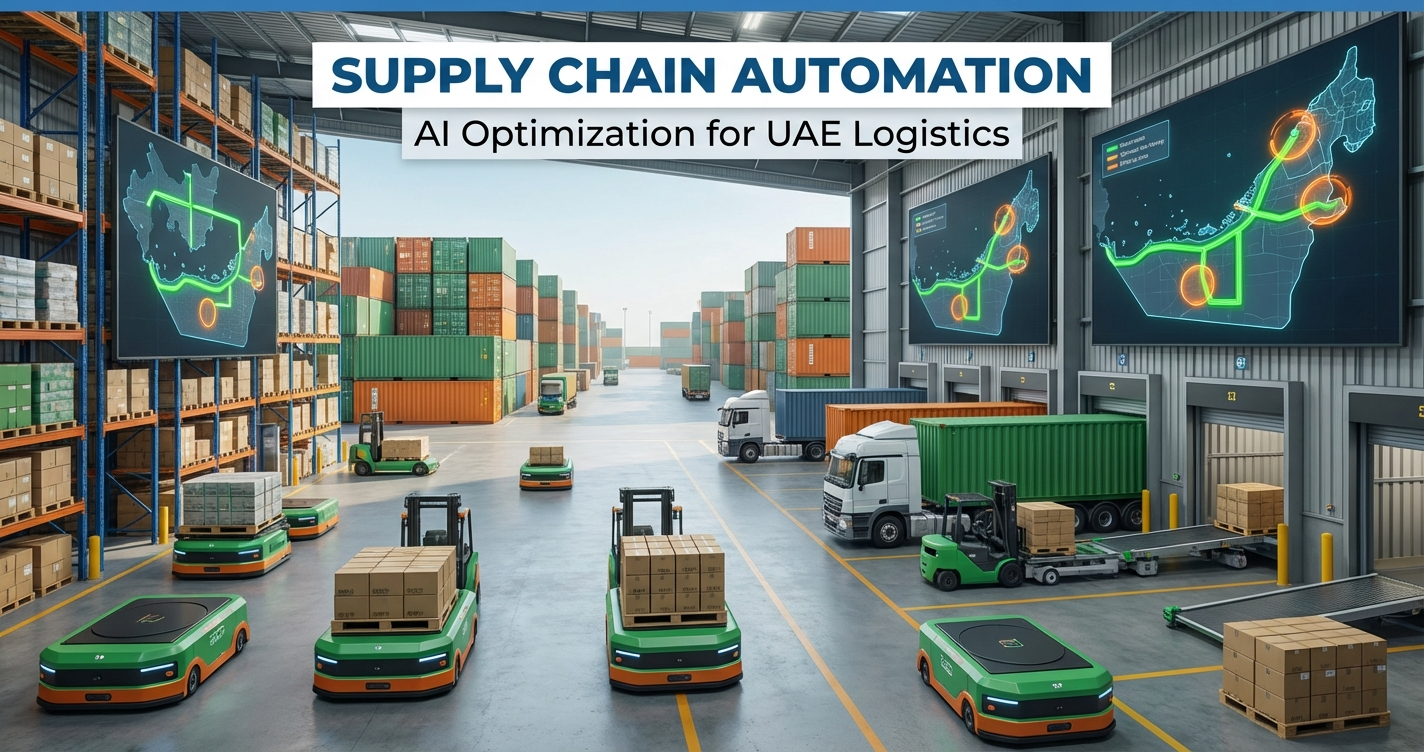
UAE logistics companies can reduce inventory management costs by 30-40% and improve delivery speed by 25-35% using AI automation for demand forecasting, route optimization, and real-time shipment tracking. Implementation typically costs AED 20,000-75,000 initially, with AED 5,000-18,000 monthly services, creating ROI within 6-12 months through labor reduction, fuel savings, and improved asset utilization.
Table of Contents
- The Supply Chain Crisis in UAE Logistics
- AI Automation Use Cases in Logistics
- Demand Forecasting and Inventory Optimization
- Route Optimization and Fuel Cost Reduction
- Real-Time Tracking and Warehouse Automation
- Implementation Framework and Costs
- Real-World Examples from Dubai and Abu Dhabi
- Frequently Asked Questions
- Next Steps
The Supply Chain Crisis in UAE Logistics
The UAE logistics sector is experiencing unprecedented growth and complexity. As one of the world's largest re-export hubs (processing 13+ million TEU annually through Jebel Ali Port), UAE supply chains manage goods flowing to 180+ countries. However, this growth has created operational bottlenecks that manual processes simply cannot handle efficiently.
The Current Challenges:
1. Inventory Inefficiency
- Average holding costs for logistics companies: AED 8,000-15,000 per SKU annually
- 20-30% of inventory in UAE warehouses is slow-moving or obsolete
- Manual inventory tracking leads to 15-20% forecasting errors
- Safety stock buffers inflate working capital by 25-35%
2. Route Inefficiency
- Average vehicle utilization in UAE logistics: 65-70% (industry standard: 85%+)
- Fuel costs: AED 1.50-2.00 per liter; fuel is 25-30% of operating costs
- Manual route planning wastes 8-12% of fuel monthly
- Average delivery cost in Dubai: AED 25-40 per delivery
3. Labor Bottlenecks
- Warehouse operations require 1 employee per 50-80 m³ of goods daily
- Average wage: AED 3,500-6,000/month
- For a 20,000 m³ warehouse: AED 300,000-400,000 monthly in labor
- Staff turnover: 35-45% annually, driving constant retraining costs
4. Visibility Gaps
- Real-time tracking limited to major shipments only
- Customs clearance delays at ports (average 2-5 days)
- 35-40% of delays attributed to poor coordination
- Lost or misplaced shipments: 2-5% of daily volume
5. Compliance Complexity
- UAE Customs requirements, DFSA regulations, and environmental mandates
- E-invoicing mandatory since January 2024
- Dangerous goods classification requires expert oversight
- Compliance violations: fines AED 10,000-50,000 per incident
- Bilingual documentation: AI automation processes bilingual (Arabic/English) shipping documents and customs forms natively
AI automation directly addresses every challenge above.
AI Automation Use Cases in Logistics
1. Demand Forecasting and Inventory Optimization
Demand forecasting is the foundation of supply chain efficiency. Traditional methods rely on historical data and human judgment—both prone to seasonal blind spots and market shifts.
AI-powered forecasting:
- Analyzes 5+ years of historical sales data alongside external variables
- Detects seasonality patterns (Ramadan peaks, summer slowdowns, year-end surges)
- Incorporates external data (weather, holidays, economic indicators)
- Predicts demand 3-6 months in advance with 85-95% accuracy
- Recommends optimal safety stock levels
- Flags slow-moving inventory before it becomes dead stock
Real-world impact: A Dubai-based automotive parts distributor reduced inventory holding costs by 28% (AED 150,000 annually saved) while improving order fulfillment from 87% to 96%.
Business impact for a typical 50-person logistics company:
- Inventory reduction: 18-25% (working capital freed up: AED 200,000-400,000)
- Holding cost savings: AED 60,000-100,000 annually
- Improved fulfillment rate: 87% → 94%+
- Faster cash conversion cycle
2. Route Optimization and Fuel Cost Reduction
Route optimization is where AI logistics creates immediate, measurable savings. Vehicle fuel costs typically represent 25-30% of operating expenses.
AI route optimization works by:
- Analyzing vehicle capacity, weight, and dimensions against load constraints
- Computing optimal pickup/delivery sequences
- Incorporating real-time traffic data from multiple sources
- Factoring delivery time windows (customer availability, customs processing)
- Dynamically re-routing based on traffic updates and new orders
- Minimizing vehicle emissions and environmental compliance
- Supporting multi-stop, multi-vehicle routing
Mathematical impact:
- Average improvement: 12-18% fewer miles driven
- Fuel savings: AED 1,200-2,400 per vehicle monthly (20% reduction)
- For a fleet of 50 vehicles: AED 60,000-120,000 annual fuel savings
- Additional benefit: Fewer hours on road = 25-30% more daily deliveries
Real example: A Dubai freight forwarding company with 40 vehicles reduced daily route distance from 420 km/vehicle to 360 km/vehicle (14% improvement). Annual impact:
- Fuel savings: AED 84,000
- Additional deliveries: 5,200 more deliveries annually
- Revenue impact: AED 130,000-180,000
3. Warehouse and Inventory Management Automation
Modern AI systems integrate with warehouse management systems (WMS) and IoT sensors.
Warehouse automation includes:
Real-time inventory tracking:
- RFID and barcode scanning feed live inventory data
- AI predicts inventory levels and alerts managers
- Prevents stockouts and overstock
Automated picking optimization:
- AI recommends optimal picking routes (reducing walking distance by 30-40%)
- Batch orders intelligently to reduce touches on goods
- Wave planning by destination and time window
Cross-dock and consolidation:
- AI identifies shipments that can be consolidated
- Reduces shipping cost automatically
Returns processing:
- Automates inspection and restock decisions
- Reduces days to refund from 7-10 days to 2-3 days
Impact: A 20,000 m³ Abu Dhabi warehouse reduced picking time by 35%, increasing throughput from 400 orders/day to 620 orders/day without additional staff.
4. Last-Mile Delivery Optimization
Last-mile delivery accounts for 40-55% of total logistics cost.
Features:
- Geofencing and customer tracking (notify customer 15-30 min before arrival)
- Proof of delivery automation (photos, e-signatures, timestamp proof)
- Dynamic dispatch (assigning orders to nearest available driver)
- Driver behavior analytics (detecting inefficient routing)
- Delivery date/time optimization
Impact: Dubai-based last-mile operator reduced failed delivery attempts from 18% to 6%, improving on-time delivery from 82% to 94%.
5. Supplier and Vendor Management Automation
AI automation extends to supplier collaboration:
Features:
- Automated purchase order generation based on forecasted demand
- Supplier performance tracking (on-time %, quality issues, pricing)
- Contract compliance monitoring
- Price optimization (identifying lowest-cost suppliers)
- Lead time prediction
Impact: A 15-person procurement team reduced sourcing cycle from 5-7 days to 1-2 days by automating supplier comparison. Annual savings: AED 45,000-80,000.
Demand Forecasting and Inventory Optimization: Deep Dive
Inventory is a strategic asset for logistics companies. Too little and you lose sales; too much and you waste capital. AI forecasting bridges this gap.
How AI Demand Forecasting Works
Step 1: Data Collection
- Historical sales (24-60 months)
- External factors: weather, holidays, economic indicators
- Seasonal patterns (Ramadan, summer, year-end)
- Trend data (growing vs. declining categories)
Step 2: Model Training
- AI analyzes relationships between variables
- Learns seasonal patterns and market shifts
- Learns economic indicator impacts
Step 3: Forecasting
- Forecast demand 1 month, 3 months, 6 months ahead
- Provide confidence intervals
- Update forecasts weekly with fresh data
Step 4: Inventory Optimization
- Calculate Economic Order Quantity (EOQ)
- Set automated reorder points
- Identify slow-moving items
- Recommend safety stock levels
Business Impact
For a logistics company with AED 5 million in annual inventory:
Before AI:
- Inventory holding rate: 25% annually (AED 1.25M cost)
- Inventory turns: 4x annually
- Stockout rate: 12% of orders
- Overstock: 22% of SKUs
After AI:
- Inventory holding rate: 18% annually (AED 900K cost)
- Inventory turns: 5.5x annually
- Stockout rate: 4% of orders
- Overstock: 8% of SKUs
- Working capital freed: AED 350,000+
Route Optimization and Fuel Cost Reduction: Technical Details
Modern route optimization uses a combination of algorithms and real-time data.
Vehicle Routing Problem (VRP) Optimization
Traditional routing is mathematically complex. Human routing solves it heuristically and imperfectly.
AI optimization:
- Constraint handling: vehicle capacity, time windows, driver regulations
- Objective optimization: minimize miles/fuel while maximizing deliveries
- Real-time adaptation: re-optimize within seconds when conditions change
- Multi-objective optimization: balance fuel cost, delivery time, driver satisfaction
Real-Time Traffic Integration
AI systems integrate with:
- Google Maps API (real-time traffic)
- Waze community data
- Local Dubai/Abu Dhabi traffic systems
- Weather APIs
Re-optimization happens every 10-15 minutes as conditions change.
Environmental and Compliance Factors
UAE environmental goals incentivize efficient routing:
AI optimization includes:
- Emission minimization (efficient routes = lower CO2)
- Electric vehicle (EV) routing (planning within battery range)
- Port congestion avoidance (optimizing pickup times)
- Customs clearance timing
- Hours-of-service compliance (driver fatigue regulations)
- Dangerous goods routing (hazmat vehicles on specified roads only)
- Environmental zone compliance
Real-Time Tracking and Warehouse Automation
GPS and IoT Integration
Modern logistics uses:
- GPS trackers in every vehicle (real-time location)
- IoT sensors in warehouses (temperature, humidity, motion detection)
- RFID tags on pallets/boxes (automated inventory tracking)
- Mobile devices for drivers (proof of delivery, real-time updates)
AI layer connects all this data:
- Predicts delivery time based on current location and traffic
- Alerts customers 15-30 min before arrival
- Detects anomalies (vehicle stopped for >10 min)
- Optimizes warehouse operations based on real-time inventory
Warehouse Automation Impact
A typical 20,000 m³ warehouse operation:
Before automation:
- Staff: 15 warehouse workers, 2 supervisors (AED 280,000/month)
- Processing: 400-450 orders/day
- Error rate: 4-6%
- Inventory count time: 2-3 days quarterly
After automation:
- Staff: 12 warehouse workers, 1 supervisor (AED 220,000/month)
- Processing: 620-700 orders/day (+50% throughput)
- Error rate: 0.5-1% (99%+ accuracy)
- Inventory count time: 4-6 hours (continuous, real-time)
Annual warehouse savings: AED 720,000
Impact on Jebel Ali Port Operations
Jebel Ali Port handles 13+ million TEU annually—one of the world's busiest container ports.
Port Operation Challenges
- Vessel turnaround time: Average 3-5 days per ship
- Customs clearance: 2-5 day average
- Truck dwell time: Average 2-3 hours inside port
- Congestion: Peak hours create bottlenecks
AI Optimization Impact
Predictive arrival planning:
- AI forecasts port congestion based on vessel schedules and weather
- Recommends optimal timing for truck pickups
- Pre-processes customs documentation
Real example: A Dubai freight forwarding company reduced average port dwell time from 2.5 hours to 1.1 hours per truck (56% improvement) by:
- Submitting all documentation 24 hours in advance
- Scheduling pickups during off-peak times
- Using AI to pre-identify which containers need inspection
Annual impact: AED 180,000 savings in truck hours (30 trucks × 260 days × 1.4 hours saved × AED 175/hour).
Implementation Framework and Costs
Phase 1: Assessment (Weeks 1-2)
- Audit current logistics operations
- Analyze historical shipping data
- Identify highest-impact automation opportunities
- Cost: AED 5,000-12,000
Phase 2: System Integration (Weeks 3-6)
- Connect to logistics management system
- Integrate GPS/IoT devices
- Set up data pipelines
- Configure WMS integration
- Cost: AED 15,000-35,000
Phase 3: Configuration and Optimization (Weeks 7-10)
- Train AI models on your historical data
- Configure demand forecasting
- Optimize route parameters
- Run pilot testing
- Cost: AED 8,000-20,000
Phase 4: Training and Rollout (Weeks 11-12)
- Train drivers and warehouse staff
- Gradual rollout to full fleet
- Real-time monitoring and optimization
- Cost: AED 4,000-10,000
Total First-Year Investment:
- Setup: AED 32,000-77,000
- Monthly service (Year 1): AED 5,000-15,000 × 12 = AED 60,000-180,000
- Total Year 1: AED 92,000-257,000
ROI Calculation
For a company with:
- 50-vehicle fleet (AED 600,000 monthly operating cost)
- 20,000 m³ warehouse (AED 250,000 monthly labor)
- Annual revenue: AED 15-25 million
Expected savings:
- Fuel optimization: 15-18% reduction = AED 30,000-40,000/month
- Delivery efficiency: 10-12% improvement = AED 25,000-35,000/month additional capacity
- Warehouse labor: 15-20% reduction = AED 37,000-50,000/month
- Total monthly savings: AED 92,000-125,000
- Annual savings: AED 1,104,000-1,500,000
Payback period: 1-3 months (savings exceed setup costs immediately)
Real-World Examples from Dubai and Abu Dhabi
Case Study 1: Dubai Distribution Company (50 vehicles)
Challenge: Managing 150-200 deliveries daily across Dubai and Northern Emirates.
Solution: Implemented AI route optimization and demand forecasting.
Results (6 months):
- Vehicle utilization: 68% → 81% (13% improvement)
- Deliveries per vehicle: 3.2 → 4.1 (+28%)
- Fuel costs: AED 360,000 → AED 298,000/month (AED 62,000/month savings)
- Failed deliveries: 14% → 5%
- Route planning time: 3.5 hours → 20 minutes
- Annual impact: AED 744,000 savings + AED 180,000 additional revenue
Case Study 2: Abu Dhabi Warehousing and Logistics (3 warehouses, 15,000 m³)
Challenge: High holding costs, slow-moving inventory, slow fulfillment.
Solution: Implemented demand forecasting and warehouse automation.
Results (12 months):
- Inventory reduction: 22% (AED 264,000 freed working capital)
- Holding cost: AED 1.2M → AED 870,000 annually (AED 330,000 savings)
- Inventory accuracy: 87% → 99.2%
- Slow-moving items: 25% → 8%
- Order fulfillment speed: 2.3 days → 1.1 days (50% improvement)
- Annual impact: AED 330,000+ savings, improved cash flow
Case Study 3: Port Freight Forwarding (50-70 shipments daily via Jebel Ali)
Challenge: High customs clearance delays and documentation errors.
Solution: Automated customs documentation and port scheduling optimization.
Results (6 months):
- Port dwell time: 2.8 hours → 1.3 hours (54% improvement)
- Customs clearance success: 70% first-pass → 96% first-pass
- Truck turnaround: 3.5 hours → 2.1 hours (40% faster)
- Penalties for documentation errors: AED 8,500/month → AED 800/month
- Annual impact: AED 86,000 savings in penalties + AED 380,000 in truck productivity gains
Frequently Asked Questions
What logistics data do I need to implement AI automation?
Ideally 24-36 months of historical data including:
- Historical shipments (origin, destination, weight, value, date)
- Vehicle utilization data (hours, distance, fuel, capacity)
- Customer demand (order frequency, quantities, seasonality)
- Delivery performance (on-time %, failed deliveries)
Implementation can proceed with limited data (6-12 months), but accuracy improves significantly after 24 months.
How accurate are AI route optimization and demand forecasting?
- Route optimization: 85-95% as optimal as manual planning (often better)
- Demand forecasting: 85-95% accuracy for stable products, 70-80% for volatile products
- Accuracy improves: Forecast accuracy typically increases 2-4% annually
Does AI automation require new software or can it integrate with existing systems?
AI automation integrates with existing systems:
- Logistics management software: Descartes, local providers
- Warehouse management systems (WMS): SAP, Oracle, local providers
- ERP systems: Microsoft Dynamics, SAP
- Communication: Email, SMS, mobile apps
Integration typically takes 2-4 weeks and costs AED 8,000-20,000.
What is the typical payback period?
For logistics companies, payback is very fast:
- Fuel/route optimization: 30-60 days
- Warehouse automation: 90-180 days
- Demand forecasting: 120-180 days
- Combined approach: 60-120 days for breakeven
Most logistics companies see positive ROI within 3-6 months.
How much can I save with AI automation?
Typical savings for a 50-vehicle, AED 15-25M revenue company:
- Fuel optimization: AED 30,000-50,000/month
- Labor reduction: AED 20,000-40,000/month
- Improved throughput: AED 15,000-30,000/month additional capacity
- Total: AED 65,000-120,000/month
Smaller companies (AED 5-10M revenue): AED 15,000-35,000/month savings typically.
Does AI automation work for small logistics operators?
Yes, but ROI differs:
- Minimum viable scale: 15-20 vehicles or 5,000+ m³ warehouse
- Below this, efficiency gains are harder to justify
- Alternative: Use shared AI platforms (pay per shipment)
For small operators: AED 2,000-5,000 monthly for shared platform access (no setup cost).
How long does implementation take for a fleet of 50 vehicles?
- Assessment: 2 weeks
- Integration: 3-4 weeks
- Configuration: 4 weeks
- Training: 1-2 weeks
- Full rollout: 10-12 weeks total
Quick-start pilot (10 vehicles): 6-8 weeks to see initial results.
Can AI handle special requirements (hazmat, temperature-controlled, oversized loads)?
Yes. AI systems can incorporate:
- Dangerous goods routing (hazmat vehicles on specified roads only)
- Temperature-controlled monitoring (real-time alerts if equipment fails)
- Oversized load permits (automatic permit booking)
- Customs-specific routing (red/green lane optimization)
Implementation adds AED 5,000-15,000 but enables compliant automation.
About Sinasoft
Sinasoft is a Dubai-based AI automation consultancy specializing in custom AI solutions for UAE businesses, including logistics companies, freight forwarders, distribution centers, and supply chain teams. We help organizations implement compliant, scalable automation that reduces operational costs, improves service quality, and unlocks growth.
Sinasoft's logistics automation experience includes:
- Route optimization for vehicle fleets (20-500+ vehicles)
- Demand forecasting for distribution and warehousing
- Port and Jebel Ali clearance optimization
- Last-mile delivery automation
- Warehouse management system integration
- Customs documentation automation
Next Steps
Ready to transform your supply chain with AI automation?
Book a free 45-minute supply chain assessment with a Sinasoft logistics specialist. We'll:
- Audit your current operations (vehicles, routes, warehouse, port processes)
- Identify high-impact automation opportunities
- Model projected savings (fuel, labor, throughput improvement)
- Provide a detailed implementation timeline and investment estimate
Contact Sinasoft:
- Email: [email protected]
- Website: sinasoft.co/logistics-automation
Early-bird offer: Companies implementing supply chain automation by March 31, 2026 receive a complimentary port clearance optimization audit (AED 8,000-12,000 value) plus 30 days of additional implementation support at no extra cost.