Quick Answer
AI automation reduces UAE logistics costs by 15-30% through intelligent route optimization, warehouse robotics, predictive inventory management, and real-time supply chain visibility. UAE logistics companies deploying AI report savings of AED 3,720-7,440 per employee monthly, equivalent to AED 37,200-74,400 annually for a 10-person team. ROI is typically achieved within 12-18 months, with ongoing cost savings of 20-40% in fuel, labor, and inventory carrying costs offsetting initial technology investment.
Table of Contents
- The UAE Logistics Opportunity
- How AI Reduces Fuel and Route Costs
- Warehouse Automation and Labor Efficiency
- Predictive Inventory Management
- Real-Time Supply Chain Visibility
- Implementation and ROI Timeline
- Frequently Asked Questions
- Real-World UAE Examples
- About Sinasoft
The UAE Logistics Opportunity
The UAE is positioned as the world's logistics hub, with Dubai's Jebel Ali Port handling over 15 million containers annually and Dubai South as a regional gateway. The sector is projected to grow from AED 81.6 billion (USD 22.2 billion) in 2024 to AED 112.6 billion (USD 30.7 billion) by 2030—a 38% expansion.
This growth creates a critical challenge: handling increasing volume without proportional increases in labor and operational costs.
UAE logistics faces structural pressure from:
- Rising labor costs in a competitive market
- Fuel expenses (25-30% of transport operations)
- Inventory carrying costs (AED 1 million inventory at 2% monthly interest = AED 20,000 monthly)
- Complex compliance (UAE customs, Emiratization, cross-border documentation)
- Last-mile delivery routing in dense urban areas
AI automation directly addresses each pressure point, delivering measurable cost reductions that compound over time. The Ministry of Foreign Trade's AI Platform (launched January 2026) provides real-time trade intelligence and customs data to logistics operators, making AI optimization easier to implement.
How AI Reduces Fuel and Route Costs
Fuel represents 25-30% of last-mile delivery costs. A 10-truck fleet in Dubai consumes approximately AED 1,500-2,000 daily (AED 450,000-600,000 annually).
Route optimization AI reduces fuel consumption by 12-18% through:
Dynamic Route Planning: AI optimizes routes in real-time considering live traffic feeds (updated every 30 seconds), customer time windows, vehicle capacity, and driver experience. Real-world example: A Dubai logistics operator managing 15 daily deliveries across Deira, Marina, and Bur Dubai wastes 2-3 hours on suboptimal routing. AI optimization reduces this to 45 minutes, saving AED 15,000-20,000 monthly in fuel costs.
Predictive Maintenance: IoT sensors combined with AI predict vehicle failures 7-14 days before they occur. Cost impact: emergency HVAC repair costs AED 3,500-5,000 vs. AED 1,200-1,800 for planned maintenance. A 15-truck fleet experiencing 1-2 unexpected breakdowns monthly saves AED 20,400-38,400 annually.
Load Consolidation: AI identifies opportunities to consolidate partial loads into full loads and matches empty return trips with freight needing transport. A logistics operator delivering to Abu Dhabi but returning empty can pair with a shipper needing Abu Dhabi-to-Dubai transport, eliminating wasteful empty miles. Consolidation optimization reduces empty vehicle-miles by 15-25%, saving AED 5,000-12,000 monthly.
Warehouse Automation and Labor Efficiency
Labor comprises 35-45% of warehouse operating costs. A 5,000 sqm warehouse with 15-20 staff operates at annual labor cost of AED 600,000-900,000.
AI-powered warehouse automation reduces labor costs by 20-30% through:
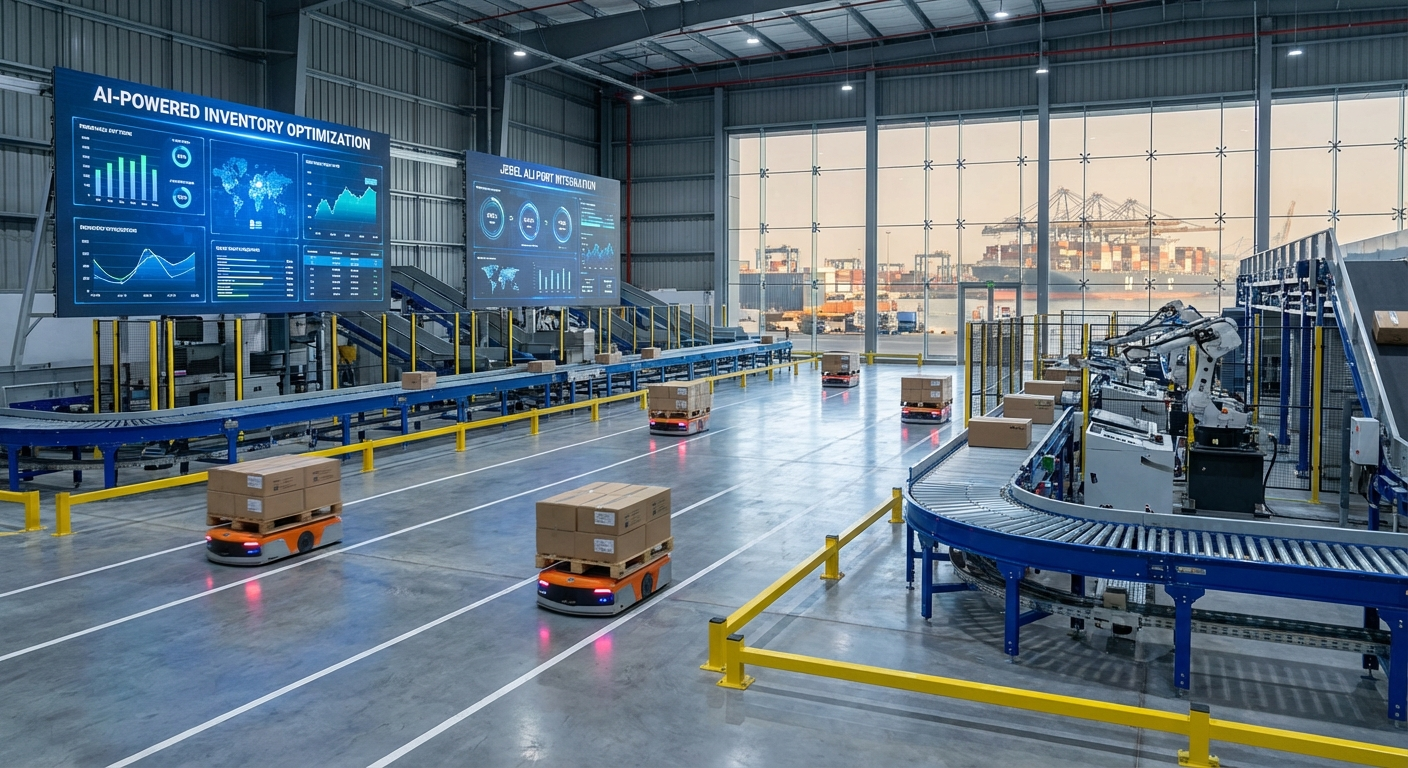
Robotics and Automated Picking: Robotic systems with AI vision achieve 99% picking accuracy (vs. 94-96% for human pickers), 3-4x faster picking speed, and 24/7 continuous operation.
Cost comparison for 5,000 sqm warehouse:
| Task | Manual Cost/Year | Robotic Cost/Year | Savings |
|---|---|---|---|
| Picking | AED 300,000 | AED 120,000 | AED 180,000 |
| Packing | AED 200,000 | AED 100,000 | AED 100,000 |
| Inventory management | AED 100,000 | AED 30,000 | AED 70,000 |
| Total | AED 600,000 | AED 250,000 | AED 350,000 |
Robotic warehouse implementation costs AED 2-3 million, delivering ROI within 6-9 months.
AI Task Assignment: Rather than assigning all pickers to all tasks, AI optimizes based on individual capabilities, physical workload, real-time demand, and fatigue patterns. This improves productivity by 15-20% while reducing injuries and burnout.
Inventory Location Optimization: AI positions items for next demand in high-speed picking zones, reducing walking distance by 20% and finding items 30% faster. This equals removing 4-5 positions from a 20-person team—AED 160,000-200,000 annual savings.
Predictive Inventory Management
Excess inventory ties up capital; insufficient inventory creates stockouts. AI optimizes this balance through predictive demand forecasting.
Traditional inventory management uses historical averages. AI considers seasonal patterns, local events (Ramadan, National Day), economic indicators, competitor actions, and supply chain disruptions.
Cost impact: A logistics company holding AED 50 million inventory at 2% monthly carrying cost pays AED 1,000,000 monthly in financing, storage, and obsolescence.
AI-driven inventory reduction of 15% saves:
- AED 150,000 monthly financing costs
- AED 20,000 monthly storage reduction
- AED 30,000 monthly spoilage reduction
- Total: AED 200,000 monthly = AED 2.4 million annually
This savings typically exceeds AI system costs within 6-8 months.
Real-Time Supply Chain Visibility
Supply chain disruptions cost UAE logistics companies millions annually. AI-powered supply chain control towers integrate data from ports, customs, traffic systems, weather services, and logistics partners.
This visibility enables proactive intervention. Example: Port congestion detected 4 hours in advance allows 2-hour dispatch delays, avoiding 3-hour queues. Cost saved: AED 600-800 in fuel and driver time per truck. For a 20-truck operation, detecting 2-3 major disruptions monthly saves AED 12,000-24,000 monthly (AED 144,000-288,000 annually).
Customs and Compliance Automation: AI automates document classification, duty calculation, compliance checking, and exception flagging. This reduces clearance time by 40-50%, equivalent to AED 500-2,000 in reduced port holding fees per shipment. For 500 monthly imports, this equals AED 250,000-1,000,000 annual savings.
Implementation and ROI Timeline
Months 1-2: Assessment - Audit operations, identify high-ROI opportunities (typically fuel optimization first). Cost: AED 50,000-100,000
Months 3-6: Pilot - Deploy to 1-2 routes or 1 warehouse section, train staff, refine algorithms. Cost: AED 150,000-300,000
Months 6-9: Full Deployment - Roll out across entire network, integrate with partners. Cost: AED 300,000-800,000
ROI Achievement: Months 9-14
A mid-sized operator (20-truck fleet, 2 warehouses) investing AED 500,000-700,000 typically achieves ROI within 12-14 months and realizes AED 1,200,000-1,800,000 annual ongoing cost savings with payback ratio of 1.7-2.5x.
Frequently Asked Questions
How much can UAE logistics companies save with AI automation?
UAE logistics companies typically save AED 3,720-7,440 per employee monthly. For a 10-person team, this equals AED 37,200-74,400 annually. Larger operators achieve 15-30% total logistics cost savings, equivalent to AED 5-15 million annually.
What is the actual ROI timeline for UAE logistics AI implementation?
ROI is achieved within 12-18 months. Fuel optimization and route planning show fastest ROI (6-9 months); warehouse automation takes longer (12-18 months) but generates larger absolute savings. A AED 500,000 investment recovers costs within 14 months, then realizes AED 1.2-1.8 million annual net benefits.
Can AI handle UAE customs regulations and compliance?
Yes. AI systems trained on UAE customs rules, free zone regulations, and regional trade agreements automate compliance checks, documentation processing, and duty calculations. The Ministry of Foreign Trade's AI Platform provides real-time regulatory data. This automation reduces customs clearance time by 40-50%.
Does AI work with Arabic-language documentation in UAE logistics?
Absolutely. Modern AI systems process Arabic documentation including certificates of origin, bills of lading, and customs declarations. OCR technology trained on Arabic business documents achieves 97-99% accuracy. Arabic documentation processing is essential for UAE logistics.
How should UAE logistics companies approach AI implementation?
Start with high-ROI, low-complexity use cases: fuel/route optimization first, then inventory management, then warehouse automation. Begin with a pilot (1-2 routes or 1 warehouse), measure results, then scale. Partner with AI consultants familiar with UAE logistics and customs requirements.
What happens to warehouse staff when AI automation is implemented?
Rather than eliminating jobs, AI shifts warehouse roles from manual picking/packing to supervision, quality control, and robotic system maintenance. Many companies report staff retraining into higher-skilled roles reduces turnover and improves satisfaction.
How does real-time supply chain visibility reduce costs?
Real-time visibility enables proactive problem-solving before disruptions impact operations. Detecting port congestion in advance, identifying inventory issues before stockouts, and flagging compliance problems before customs delays compound into major cost savings—typically AED 200,000-500,000 annually for mid-sized operators.
What is the cost of deploying AI in UAE logistics?
Deployment costs vary: (1) Route optimization software: AED 50,000-150,000 annually; (2) Warehouse automation: AED 2-3 million for 5,000 sqm; (3) Supply chain visibility platform: AED 200,000-500,000 setup plus AED 50,000-100,000 annually. Most start with route optimization and inventory management (AED 200,000-400,000) before warehouse automation.
Can small and medium UAE logistics companies afford AI automation?
Yes. SaaS-based AI solutions allow SMEs to access enterprise-grade logistics AI without massive upfront capital investment. Monthly costs of AED 5,000-15,000 for route optimization and inventory management are justified by cost savings.
Real-World UAE Examples
Dubai Traders Initiative + IQ Fulfillment: AI-Powered SME Logistics
In February 2026, Dubai Department of Economy and Tourism partnered with IQ Fulfillment to provide AI-powered logistics to UAE SMEs:
- 99% order accuracy vs. 94-96% manual
- 20% cost reduction through AI optimization
- Orders processed 3-4x faster than traditional warehouses
- AI Plus analytics platform provides real-time cost and performance visibility
SME Example: A Dubai e-commerce company with 500 daily orders deployed IQ Fulfillment's system. Processing time reduced from 4 days to 1 day, labor costs reduced AED 8,000/month, inventory carrying costs reduced 18%.
Ministry of Foreign Trade AI Platform: Real-Time Trade Intelligence
Launched January 2026, this platform provides UAE logistics companies real-time port data, customs intelligence, trade forecasting, and partner visibility integration. Logistics companies achieve 15-25% improvement in clearance times and 12-18% reduction in customs-related delays.
Agility Global Logistics: Autonomous Transportation
Agility deployed autonomous vehicle pilot programs in Dubai and Abu Dhabi:
- Reduced driver costs through autonomous vehicles (eliminating AED 4,000-6,000/month per vehicle)
- 24/7 operations without fatigue-related limits
- Improved safety by eliminating human error
- Fuel efficiency reduced 18-22% through AI route optimization
By 2027, 10-15% of Agility's Gulf fleet is expected to operate autonomously, reducing operating costs by AED 50-80 million annually across Gulf operations.
About Sinasoft
Sinasoft is a Dubai-based AI automation consultancy specializing in custom AI solutions for UAE logistics, supply chain, and transportation companies. We help logistics operators reduce costs, improve efficiency, and achieve competitive advantage through AI implementation tailored to your operations and regulatory environment.
Our approach combines deep domain expertise in UAE customs, port operations, and regional trade patterns with technical excellence in route optimization, predictive analytics, and supply chain visibility. We build AI systems that integrate with your existing logistics infrastructure and deliver measurable cost reductions within 12-18 months.
Next Steps
Ready to reduce logistics costs with AI automation? Let's talk.
Whether you're considering route optimization, warehouse automation, inventory management, or supply chain visibility, Sinasoft can guide your implementation from cost analysis through deployment.
Schedule a 30-minute consultation with our UAE logistics AI specialists:
📧 Email: [email protected]
🌐 Website: sinasoft.co
We'll assess your current operations, model cost savings specific to your business, and outline a realistic implementation roadmap tailored to your fleet size and budget.
The UAE logistics market is becoming increasingly AI-driven. Companies that deploy AI early will capture significant cost advantages while competitors are still optimizing manually. Let's make sure your company is leading, not following.
Keywords: AI logistics UAE, supply chain automation Dubai, warehouse automation robotics, route optimization, logistics cost reduction, UAE customs AI, predictive inventory management, supply chain visibility, AI driven cost savings, logistics software UAE, last-mile delivery optimization, port operations AI, inventory management AI, demand forecasting, AED pricing, Middle East logistics automation