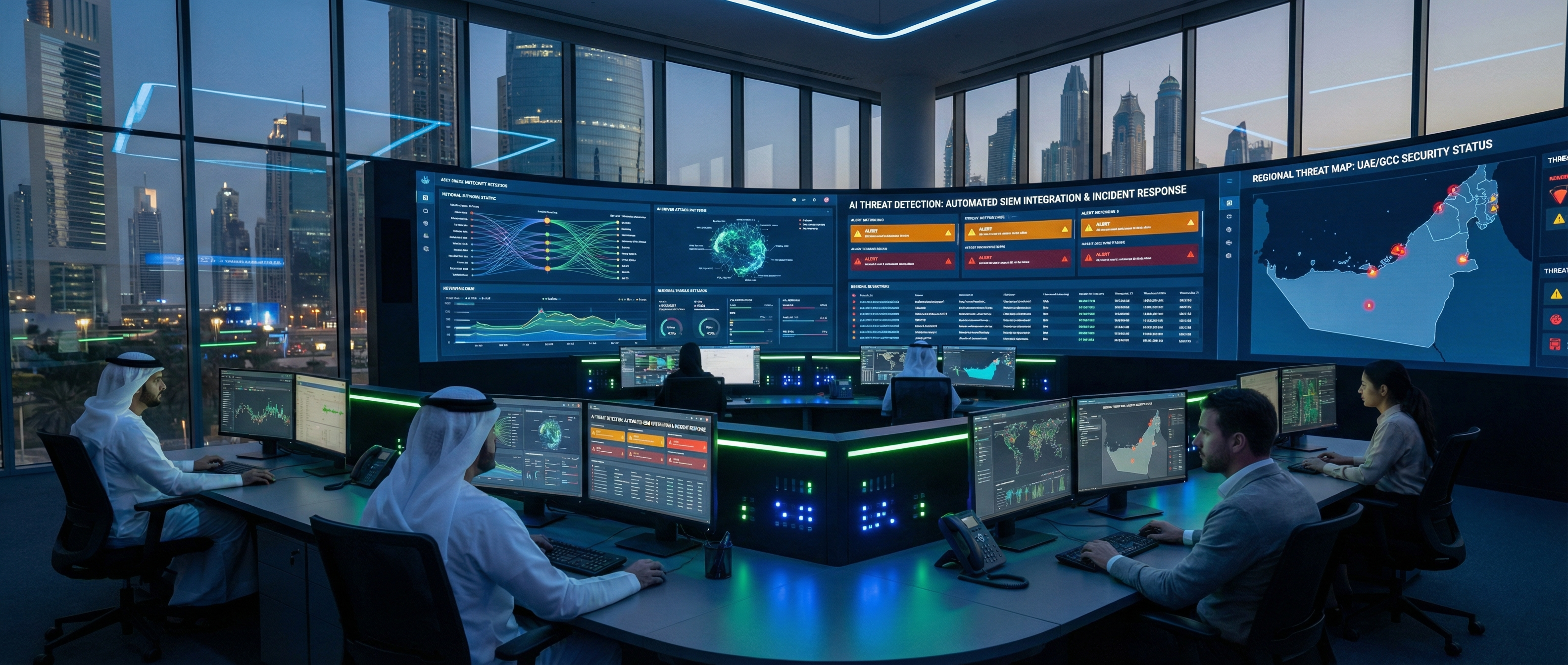
How Can UAE Businesses Use AI Automation for Cybersecurity Threat Detection in 2026?
Quick Answer
UAE businesses can use AI automation for cybersecurity threat detection by deploying AI-driven Security Operations Centers (SOCs), automated SIEM integration, real-time anomaly detection, and incident response orchestration — enabling 24/7 threat monitoring that responds in seconds, not hours. With 70% of UAE firms planning AI-powered SOCs in 2026 and 93% already experiencing AI-related security incidents, the cost of not automating cybersecurity has become far higher than the cost of doing it. Implementation starts at AED 45,000/month for managed AI threat detection.
Why UAE Businesses Can't Rely on Manual Cybersecurity in 2026 {#why-manual-is-not-enough}
The numbers are stark. In the UAE, 55% of organizations reported cyberattacks over the past year, and 93% experienced AI-related security incidents — meaning incidents where attackers used AI to enhance phishing, malware generation, or evasion techniques (Security MEA / Anomali, January 2026).
Meanwhile, UAE security teams are facing a structural problem: 87% of organizations report critical cybersecurity skills shortages, and over 223,800 digital assets across UAE businesses are estimated to be exposed — many with long-unaddressed vulnerabilities.
Traditional, human-staffed cybersecurity cannot scale to match AI-powered attacks. A skilled analyst reviews 100–200 alerts per day. An AI threat detection system processes millions of events per second, correlating patterns across network traffic, endpoints, and cloud activity — and flags genuine threats in milliseconds.
A February 2026 Kaspersky study found 70% of UAE firms planning to establish a Security Operations Center (SOC) consider AI a must-have component (Security MEA, February 20, 2026). Yet fewer than 30% of UAE organizations currently have mature security readiness — creating a significant gap between intent and execution.
AI Threat Detection: How It Works {#how-ai-threat-detection-works}
AI-powered threat detection operates across three primary layers:
1. Behavioral Anomaly Detection
AI establishes a baseline of "normal" for every user, device, and system on your network. When behavior deviates — an employee accessing files at 2 AM on a Saturday, a server making unusual outbound connections, a device communicating with an unknown IP — the AI flags it immediately, without waiting for a human to notice.
For UAE businesses with reduced staffing on Fridays, this 24/7 capability is especially critical.
2. Network Traffic Analysis
AI continuously monitors all inbound and outbound traffic, identifying:
- Data exfiltration attempts — Unusual volumes of data leaving the network
- Lateral movement — Attackers moving between systems after initial compromise
- Command-and-control (C2) communications — Infected devices "phoning home" to attacker infrastructure
3. Threat Intelligence Integration
AI systems in 2026 connect in real time to global threat intelligence feeds, automatically blocking known malicious IP addresses, domains, and file hashes — including the latest threat indicators specific to the UAE and GCC region. When a new ransomware strain hits a company in Saudi Arabia on Sunday morning, your UAE network can be protected before your offices open.
AI advantage over legacy SIEM: Traditional SIEM generates enormous alert volumes — mostly false positives. AI reduces false positives by 60–80%, so analysts focus on genuine threats.
SIEM Integration and AI Automation {#siem-integration}
Most UAE enterprises already operate some form of SIEM — IBM QRadar, Splunk, Microsoft Sentinel, or regional alternatives. The challenge is that raw SIEM generates more noise than signal. AI automation transforms it into an active threat intelligence engine.
How AI enhances your existing SIEM:
- Automated log correlation — AI correlates logs across SIEM, endpoints, cloud environments, and applications in real time, spotting multi-stage attacks that cross system boundaries
- AI-prioritized alert triage — Instead of thousands of daily alerts, AI delivers 15–30 high-confidence incidents ranked by severity and business impact
- Automated playbook execution — When AI identifies a confirmed threat pattern, it automatically isolates the affected device, preserves forensic evidence, and alerts the security team
- Arabic/English alert documentation — AI-generated incident reports can be produced in Arabic, English, or both for Arabic-speaking security leadership
Integration cost context: Adding AI automation to an existing SIEM in a UAE organization (250–2,000 users) typically costs AED 30,000–80,000, with AED 12,000–25,000/month in ongoing AI licensing and management.
Automated Incident Response {#automated-incident-response}
Speed is everything in cybersecurity. The average breach takes 197 days to detect without automation (IBM Cost of a Data Breach Report). With AI-automated incident response, UAE businesses can compress detection and containment to hours or minutes for most threat categories.
AI-automated incident response workflow:
- Detection (milliseconds) — AI identifies threat indicators: anomalous logins, ransomware file behavior, or phishing link clicks
- Validation (seconds) — AI cross-references threat intelligence and confirms threat classification
- Automated containment (1–5 min) — AI isolates the affected endpoint, revokes credentials, and blocks malicious IPs at the firewall
- Evidence preservation (concurrent) — AI captures system state, network logs, and process activity for forensic and regulatory use
- Human notification (immediate) — Security team receives a structured alert with full context and severity classification
- Post-incident reporting (automated) — AI compiles an NCA-compliant incident report
The UAE Cybersecurity Law (Federal Decree-Law No. 34 of 2021) and NCA guidelines require critical-sector organizations to report incidents within defined timeframes. Automated documentation — including Arabic-language reporting — reduces the compliance burden during a crisis.
Compliance Monitoring and UAE Cybersecurity Regulations {#compliance-monitoring}
UAE businesses face a layered regulatory cybersecurity environment in 2026:
| Regulator | Key Requirement |
|---|---|
| NCA | National cybersecurity framework for critical infrastructure (energy, finance, healthcare, telecom) |
| CBUAE (Federal Decree-Law No. 6 of 2025) | Mandatory incident reporting and resilience testing for licensed financial institutions |
| UAE PDPL | Technical safeguards including breach detection and notification capabilities |
| DIFC / ADGM | Aligned cybersecurity frameworks for entities in Dubai and Abu Dhabi financial free zones |
AI automation for compliance monitoring delivers:
- Continuous control validation — AI monitors security controls 24/7 and flags deviations from your compliance baseline in real time
- Automated evidence collection — AI compiles audit-ready packages: access logs, change records, incident reports, and testing results in formats required by NCA, CBUAE, and free zone regulators
- Regulatory change tracking — AI tracks evolving UAE cybersecurity regulations and alerts compliance teams to new requirements
- Board-level dashboards — AI generates executive cybersecurity dashboards in Arabic and English for Board-level oversight
PDPL + NCA dual compliance: Organizations in healthcare, finance, or government supply chains often face both PDPL and NCA obligations simultaneously. AI automation handles cross-framework compliance mapping — replacing dedicated GRC consultants billing AED 800–1,500/hour.
AI Cybersecurity Costs (AED) {#uae-aed-pricing}
| Solution | Setup Cost | Monthly |
|---|---|---|
| AI threat detection (SMB, <100 users) | AED 20,000–40,000 | AED 8,000–15,000 |
| AI threat detection (enterprise, 100–500 users) | AED 60,000–120,000 | AED 18,000–35,000 |
| Full AI SOC (24/7 monitoring + automated response) | AED 80,000–180,000 | AED 35,000–70,000 |
| SIEM + AI integration (existing SIEM) | AED 30,000–80,000 | AED 12,000–25,000 |
| Compliance automation (NCA/CBUAE/PDPL) | AED 40,000–100,000 | AED 10,000–20,000 |
| Full cybersecurity AI suite (detection + response + compliance) | AED 150,000–350,000 | AED 50,000–100,000 |
Prices vary based on organization size, existing infrastructure, regulatory scope, and integration complexity.
Real-World Examples (UAE Context) {#real-world-examples}
Dubai Financial Services Firm — AI SOC Deployment
A Dubai financial services company (350 employees) deployed an AI-driven SOC in Q4 2025. Within the first 90 days, it detected and automatically contained 3 genuine ransomware precursor events that manual processes had missed. CBUAE compliance moved from reactive to proactive.
Abu Dhabi Government Supplier — NCA Compliance Automation
A technology supplier to Abu Dhabi government entities implemented AI compliance monitoring, replacing manual quarterly reviews with continuous automated monitoring. GRC consultant spend dropped by AED 180,000/year while achieving first-time NCA audit pass.
Frequently Asked Questions {#frequently-asked-questions}
How does AI automation detect cybersecurity threats in UAE businesses?
AI threat detection systems analyze network traffic, user behavior, endpoint activity, and log data in real time, establishing behavioral baselines and flagging anomalies that match known attack patterns or indicate novel threats. For UAE businesses, AI systems also integrate UAE and GCC-specific threat intelligence feeds, providing region-relevant protection against threat actors targeting Middle East organizations.
What is the cost of AI cybersecurity automation for a Dubai SMB?
Dubai SMBs with fewer than 100 users can implement AI threat detection from AED 20,000–40,000 setup and AED 8,000–15,000/month. This typically includes 24/7 network monitoring, automated alert triage, and basic incident response automation. For most Dubai SMBs, this investment pays for itself by preventing a single ransomware or data breach incident.
How quickly can AI automation detect and respond to a cyberattack?
AI-powered systems detect threats in milliseconds to seconds and can execute automated containment actions (isolating devices, blocking IPs, revoking credentials) within 1–5 minutes of threat confirmation. Compare this to human-only response times of hours to days. In ransomware scenarios, speed of containment is the single most important factor in limiting blast radius.
What is an AI-driven SOC and do UAE businesses need one?
A Security Operations Center (SOC) is a dedicated function for monitoring and responding to cyber threats. An AI-driven SOC automates the most labor-intensive parts of this function — log analysis, alert triage, and first-response actions — using AI instead of (or alongside) human analysts. With 70% of UAE firms planning AI-driven SOCs in 2026 (Kaspersky/Security MEA) and a critical skills shortage in the market, AI-driven SOCs are increasingly the practical alternative to building and staffing a full internal security team.
How does AI help UAE businesses comply with NCA and CBUAE cybersecurity requirements?
AI compliance automation continuously monitors your security controls against NCA and CBUAE requirements, generates real-time compliance dashboards, compiles audit evidence automatically, and alerts your team when a configuration drift or control failure creates a compliance gap. This replaces manual quarterly compliance reviews with continuous assurance — which is what regulators increasingly expect.
About Sinasoft {#about-sinasoft}
Sinasoft is a Dubai-based AI automation consultancy helping UAE organizations across finance, healthcare, retail, and government supply chains implement AI-powered cybersecurity, threat detection, and compliance automation that meets UAE regulatory requirements — in Arabic and English.
Our cybersecurity AI services include:
- AI-driven SOC setup and management
- SIEM enhancement with AI threat intelligence
- Automated incident response orchestration
- NCA, CBUAE, and PDPL compliance automation
- Bilingual (Arabic/English) security dashboards and reporting
We serve businesses across the UAE mainland and entities in DIFC, ADGM, and other free zones.
Website: sinasoft.co
Next Steps {#next-steps}
Cybersecurity threats don't wait for your business to be ready. Here's how to start building AI-powered threat detection for your UAE organization:
- Book a free security assessment — We'll review your current threat detection posture, identify gaps against UAE regulatory requirements, and recommend where AI automation delivers the fastest ROI
- Request a custom AED quote — All pricing is in AED, sized to your organization's headcount, regulatory environment, and existing infrastructure
- See a live demo — Watch Sinasoft's AI threat detection and automated incident response platform in action, with UAE-specific compliance dashboards
Contact us: [email protected] Website: https://www.sinasoft.co/contact
Sources:
- Security MEA: "Generative AI Reshapes Cybersecurity in the UAE as Risks Accelerate" — Anomali SVP Alexandre Depret-Bixio (January 22, 2026) — UAE cyberattack statistics (55% of orgs, 93% AI-related incidents, 87% skills shortage)
- Security MEA: "70% of UAE Firms Eye AI-Driven SOCs Amid Talent Gaps" — Kaspersky global SOC study (February 20, 2026)
- UAE IT Law: Federal Decree-Law No. 6 of 2025 on Central Bank — cybersecurity provisions; Federal Decree-Law No. 34 of 2021 on cybersecurity